17 November 2023
18:25 – 19:10
Amphitheatre Say
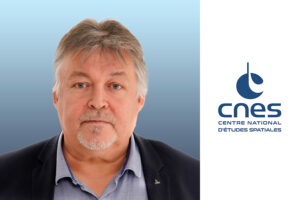
Christophe Bonnal
Christophe Bonnal has devoted his career to two complementary subjects: launchers, to send something into space, and space clutter, or how to get rid of it… Joining Aérospatiale (ArianeGroup) in 1984, then CNES in 1993, Christophe was in charge of various technical problems on Ariane 4 and 5, then started several preliminary projects, so the ATV as well as many future launchers of all sizes. He joined the Ariane 5 Industrial Architect’s team on mission aspects, before taking charge of the launcher’s system tests. After qualification of Ariane 5, Christophe managed CNES’ launcher pre-projects for 8 years, before being appointed Senior System Expert, reporting to the Director of Launchers. At the beginning of 2022, he joined the CNES Strategy Department. Christophe Bonnal has been responsible for space debris issues since 1987, and is the French delegate to the IADC, ISO and ECSS. He heads the Space Debris Commission of the International Academy of Astronautics, as well as the Space Traffic Management Commission of the International Astronautical Federation. A member of the Académie de l’Air et de l’Espace, Christophe Bonnal is the author of 270 publications, including 90 peer reviews, a book and 8 patents.
Is there a future for orbital solar power plants?
The current global energy crisis is not easy to solve: how can we generate the electricity we need on a daily basis in a sustainable and continuous way, taking into account the strong short-term increase in a society increasingly turned towards electric solutions, while respecting the constraints of global warming? A solution that has been under study for several decades now looks promising. It involves generating electricity from dedicated orbital stations. The principle is simple: the sun is continuously present in orbit, at an energy level higher than that observed on Earth, without meteorological disturbances or day-night cycles. The idea is to capture this energy, then send it to Earth for distribution to end users. However, this concept raises a number of technical issues, such as the means of collecting the energy in orbit, then transferring it to Earth; it also raises the question of the robotized assembly of very large structures, their maintenance, and the costs involved. The presentation will go into these various points in detail, to encourage listeners to form their own ideas on this subject, which is currently very popular.