5 December 2025
10:55 AM – 12:30 PM
Amphi Grand Kursaal
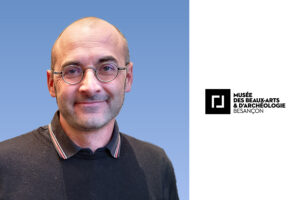
Julien Cosnuau
Julien Cosnuau has been in charge of the archaeology collections at the Besançon Museum of Fine Arts and Archaeology since June 2017. He studied at Paris 1 Panthéon-Sorbonne University and then at the University of Haute-Alsace. My work currently focuses on the history of the heritage status of archaeology in relation to the history of this discipline, particularly in Besançon and Franche-Comté. This work allows for a renewed approach to the constitution of the museum’s archaeological collections.
What are the limits of heritage conservation?
France, like every other country, has a rich and diverse heritage that must be preserved for the sake of its people’s history, social cohesion, education, economy, tourism, and research. From decorated caves with a delicate climate threatened by global warming to handwritten and digital archives that are constantly being created, not to mention the works, objects, and specimens in museums and galleries that must be preserved in perpetuity, we are reaching the limits of conservation, ecological limits, and organizational and management limits. So should we preserve everything? This question is one that all heritage institutions (museums, archives, libraries, archaeological services, historic monuments) face, each responding according to its legal framework and professional practices. Archives, which are unique by nature, are subject to a strict selection protocol. Libraries, faced with a mass of printed material, must preserve books published before 1830 but may carry out selective weeding for later works. Archaeology selects the movable archaeological property to be preserved, while museums question their acquisition policy, aware that each new object added to their inventory becomes inalienable. In all areas of heritage, selection is a fundamental act.But beyond the law and customs, other limitations arise: those of saturated spaces, limited financial resources, and overworked teams. Conservation also has an ecological cost. In the face of climate change, the risks of disasters are multiplying, while the measures used to conserve heritage (air conditioning, petroleum-based packaging, transport) weigh heavily on institutions’ carbon footprints. Heritage professionals are therefore faced with a major paradox: preserving the vestiges of the past to pass them on to future generations, but sometimes at the cost of damaging the environment. Using specific examples, particularly from the collections of Besançon’s museums (the Museums of Art and Time, the Natural History Museum, the Museum of Resistance and Deportation, and the Comtois Museum) and municipal libraries and archives, specialists will present the choices made to ensure that future generations can also take care of these shared assets.