3 December 2025
11:45 AM – 12:30 PM
Salle Proudhon
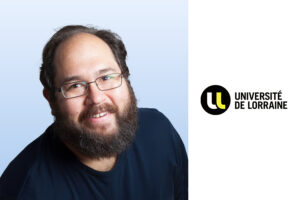
Andrew Arana
Andrew Arana is a professor of philosophy at the University of Lorraine and director of the Archives Henri-Poincaré (CNRS UMR 7117). He is a philosopher of mathematics and a logician. He recently published a book entitled Elements of Purity, published by Cambridge University Press (2024). He studies the normativity of mathematics, including the complexity of mathematical proof, and its relationship to algorithmic complexity. This work intersects with his research in proof theory, including recent work on Gaisi Takeuti’s conception of finitism and its context within the Kyoto School of philosophy. He currently holds an ANR grant on mathematical hygiene (2024-2028), a comparative project between normativity in mathematics and normativity in linguistics, studying the social and political commitments underlying thinking about mathematical and linguistic norms. He is now studying the notion of complexity in artificial intelligence, including the complexity and transparency of large language models, and how these issues affect the implementation of recent European laws regulating digital services and artificial intelligence.
Do the branches of mathematics have limits?
Mathematics has always been divided into branches (arithmetic, geometry, algebra, etc.). At the same time, these branches are constantly changing and multiplying (algebraic geometry, arithmetic geometry, algebraic topology, etc.). What is the status of these branches? Mathematics is often thought of as a fixed field, not subject to change, like the study of an eternal world. The variation of branches raises a problem in the context of this eternal view of mathematics. Some mathematicians continue to solve problems by “local” means. How does this practice adapt to the variation of branches of mathematics?