5 December 2025
9:50 AM – 10:35 AM
Amphi Petit Kursaal
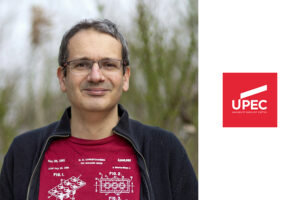
Hervé Cottin
Hervé Cottin is a professor at Paris-Est-Créteil University (UPEC), where he teaches chemistry and astronomy. He conducts research at the Interuniversity Laboratory of Atmospheric Systems (LISA). He is President of the Astrobiology Commission of the International Astronomical Union and Vice-President of the International Society for the Study of the Origin of Life (ISSOL). His research focuses on the origin and evolution of cometary organic matter. His aim is to understand the extent to which comets may have contributed to the appearance of life on Earth, and how their composition may provide information about the birth of the solar system. His work is based on laboratory experiments and measurements carried out by the Rosetta space mission. It is complemented by studies in Earth orbit outside the International Space Station. Hervé Cottin contributed to the detection of glycine (the simplest amino acid) and organic macromolecules in comet 67P/Churyumov-Gerasimenko. He is also a member of the scientific team behind the MOMA (Mars Organic Molecule Analyser) instrument, which will search for organic matter on the surface of Mars using the Rosalind Franklin rover on the European ExoMars mission.
Are we on the verge of finding extraterrestrial life?
The possibility of the existence of extraterrestrial life forms feeds an abundant imagination, which has been transcribed in countless science fiction novels and films. For some years now, the search for traces of life elsewhere than on Earth has been the subject of a scientific approach organized around space exploration missions in the solar system and observations of distant exoplanets. Occasionally, we even read or hear in the media about the detection of clues that some scientific teams suggest could be traces of extraterrestrial life. These detections are often confused and quickly contradicted, but they are widely reported in the press and on social networks. Are these the harbingers of a great discovery to come, or are they the symptoms of over-enthusiasm and false expectations on the part of the public? If we push current instruments like the James Webb Space Telescope, or the future Extremely Large Telescope, to the limit, will we be able to exceed the “detection limits” of potential life signatures? In other words, are we really on the verge of discovering that there is life elsewhere than on Earth?