4 December 2025
1:30 PM – 2:15 PM
Amphi Petit Kursaal
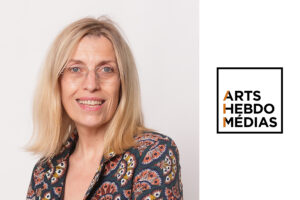
Marie-Laure Desjardins
Marie-Laure Desjardins is a journalist and art critic (AICA). Her career has spanned the daily press, magazines and the web. Since 2009, she has directed ArstHebdoMédias, a news website dedicated to contemporary art (artshebdomedias.com). A specialist in artistic practices at the intersection of art and technology, in 2020 she founded the online aesthetics journal ASTASA (astasa.org) with Cécile Croce, co-director of MICA (Bordeaux Montaigne University). With a PhD in Art Sciences, she is an associate member of MICA (ADS/ATIIA) and a lecturer at Paris 1 Panthéon Sorbonne.
Does art have a limit?
Art seems to aspire to the infinite. Yet it always arises from a capacity, a framework, a body. It comes up against the finitude of the world and feeds on it. This paradox lies at the heart of the question: does every work of art begin where something resists? If language has its abysses, if matter fractures, it is in these cracks that the artist’s gesture rushes in. In L’Air et les Songes, Bachelard notes that “imagination is the faculty that frees us from primary images, that changes images.” It is this transformation, always limited by the thickness of reality, that constitutes the artistic act. Quantum physics teaches us that no observation can be made without alteration: art, too, modifies what it touches. And yet it remains constrained by the properties of its mediums—the fragility of glass, the fusion of bronze, the saturation of pigment. These technical limits are matched by social, moral, and political thresholds: censorship, prohibitions, and the expectations of the times. But art constantly pushes these boundaries in order to transgress them. It stands on the edge of silence, to borrow from Blanchot’s spirit in L’Espace littéraire. There are also symbolic limits, whose function is less to prohibit than to reveal. When Malevich exhibited a single black square on a white background in 1915, it was not the absence of form that shocked, but the abolition of perceptual reference points, the very negation of the image. By crossing this threshold, art does not destroy its own possibility; it manifests its extreme condition. The limit here does not mark the end of meaning, but its fruitful suspension, the moment when the gaze, deprived of guidance, becomes fully active. Thus, art is not without limits; it is the place where they are expressed, shifted, sometimes dissolved, but always leaving a trace. This presentation will examine a few examples.