2 April 2024
10:55 – 11:40
Amphi 3
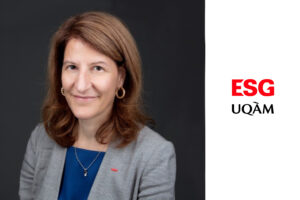
Corinne Gendron
Professor in the Department of Strategy, Social and Environmental Responsibility at the École des sciences de la gestion, Corinne Gendron heads UQAM’s Researchers in Social Responsibility and Sustainable Development group. She specializes in social and environmental responsibility, social innovation and acceptability, and governance. Recipient of several grants from SSHRC, FRQ and other organizations, she conducts research on the social representations of the economic and political elite, on the evolution of business as a social institution, and on the dynamics of social acceptability of major projects and new technologies. She has published over a dozen books and some fifty research articles. A graduate of Université de Montréal’s Faculty of Law and holder of an MBA specialized in marketing and finance from HEC Montréal, she also holds a Ph.D. in sociology from UQAM, which was awarded the prize for the best thesis by the Institut de recherche en économie (IRÉC). Throughout her career, she has been invited to several universities around the world, and was named researcher of excellence by the Lorraine Region, as well as affiliated research professor at ICN Business School from 2012 to 2021. In France, as well as being a member of several scientific or advisory boards, she also chaired the scientific boards of INERIS and IFSTTAR for several years, and currently chairs the Stakeholder Committee of the Excelia group. In Quebec, she was a member of the Strategic Environmental Assessment Committee on shale gas, and has been an additional member of the Bureau d’audiences publiques sur l’environnement (BAPE) since 2011. She is also a member of the Board of Directors of the Fonds de recherche du Québec – Société et culture (FRQSC), where she chairs the Committee on Ethics and Scientific Integrity, and was a member of the Board of Directors of UQAM from 2013 to 2020. Since 2023, she has been a member of the Ministerial Advisory Committee on the Environmental Transition of federal ministers St-Onge and Martinez Ferrada. In 2014, she was elected Académicienne at the Académie des technologies de France, where she co-chairs the Technologies, Economies et Sociétés cluster, and was elevated to the rank of Chevalier de l’Ordre national de la Légion d’honneur de France in 2015. She was also made a Fellow of the Royal Society of Canada in 2019.
How socially acceptable is the ecological transition?
Faced with the climate crisis, difficult societal choices will have to be made, both in an attempt to curb global warming and to adapt to climate change. The transition from fossil fuels to renewable or less-polluting energies is already giving rise to intense social tensions, as evidenced by citizens’ protests over the exploitation of critical and strategic minerals (graphite, lithium), the possible construction of new hydroelectric dams in Quebec, fuel taxes and the return of nuclear power in France. The local communities that will have to bear the negative externalities of these projects are often the first to react, denouncing the burden they have to endure in the name of transition. In this way, issues of environmental justice are at the heart of the debate. And they are set to intensify in the medium term, in view of the transition from energy to ecology, and the challenge to people’s lifestyles that this implies. Thus, in the face of the crisis, people are likely to be called upon to reconsider the very notion of growth that underpins our Western economies. In short, future conflicts will make the notion of social acceptability even more acute. This presentation will provide an opportunity to reflect on these issues, their effects on living together, and the factors involved in the acceptability of transition projects.