4 April 2024
09:50 – 10:35
Amphi 1
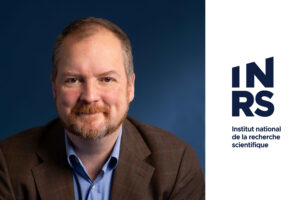
Andreas Ruediger
Andreas Ruediger is a full professor at the Institut National de la Recherche Scientifique, Centre Énergie, Matériaux et Télécommunications in Varennes. He obtained his doctorate in experimental physics in Germany in 2001, followed by a two-year post-doctorate at Cambridge University in England. Between 2003 and 2008, he was a researcher at Forschungszentrum Jülich in Allegmagne. His work focuses on structure-function relationships in polar nano-oxides, and he is associated with the UNESCO MATECSS Chair (materials for energy conversion, storage, and saving). He has co-authored over 180 papers in international peer-reviewed journals, with over 3,900 citations. He currently manages a team of 2 postdocs, 8 PhD students and two master’s students.
How are photocatalysts expected to help decontaminate wastewater?
The decontamination of water polluted by stable dyes remains a major challenge. Photocatalysis proposes the use of renewable energy to achieve a significant yield. The use of titanium dioxide in a photovoltaic device for the decomposition of water offers a much higher yield than that observed for the photocatalytic degradation of a dye. On the basis of this observation, we will question the possibility of improving catalyst efficiencies, focusing on mass transport. Our results, which take into account the volume photovoltaic effect as well as the piezoelectricity of polar nano-oxides, indicate that there is enormous potential for improvement.