2 April 2024
10:55 – 12:30
Amphi 4
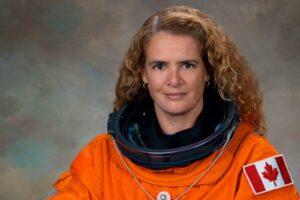
Julie Payette
As an astronaut from 1992 to 2011, Julie Payette flew two space missions, held the position of CAPCOM at NASA’s Mission Control Center for several years, and was Chief Astronaut for the Canadian Space Agency. She then contributed to the development of public policy and the promotion of science and technology. From 2011 to 2016, she was a researcher at the Woodrow Wilson Center in Washington DC and CEO of the Montréal Science Centre. She has also served on numerous boards of public companies and non-profit organizations, was a member of the International Olympic Committee’s Commission for Women in Sport, and produced science popularization capsules for Radio-Canada. Julie Payette was Canada’s 29th Governor General from 2017 to 2021. She is a member of the Ordre des ingénieurs du Québec and the International Academy of Astronautics. She holds a bachelor’s degree in electrical engineering from McGill University and a master’s degree in computer engineering from the University of Toronto. Julie Payette has received numerous distinctions and holds 28 honorary doctorates. She is a Knight of the Ordre national du Québec and a Companion of the Order of Canada.
What kind of energy is needed for space exploration?
Space exploration calls on multiple sources of energy, for example to power probes, satellites and manned space flights, not to mention the numerous pieces of equipment that also require energy. From solar panels and thermoelectric generators to batteries, nuclear reactors and chemical fuels, each source of energy comes into play, and the choice of one or other depends on the specific requirements of each mission. It would be inconceivable to talk about the energy required for a space mission without mentioning that of its crew. How do you train, organize yourself, manage your periods of activity and rest; how do you organize yourself as a team, cooperate and make decisions? Human and machine move forward together.