3 April 2024
15:25 – 16:10
Amphi 3
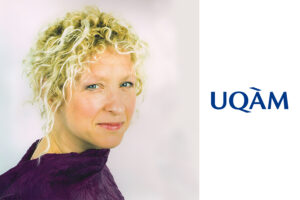
Isabelle Choinière
Isabelle Choinière, Ph.D., is an international specialist in research-creation and new hybrid contemporary performance scenes integrating technology, as well as a transdisciplinary artist. She is also a research professor (on contract) and is regularly invited to take part in research projects on the impact of media on the body in Europe, Canada and Latin America. She holds a PhD from the Planetary Collegium – Transdisciplinary Space Research/Center for Advanced Inquiry in the Integrative Arts, U. of Plymouth (UK), and a postdoctorate (Boursière FRQSC 2017-19 – Fonds de recherche du Québec – Société et Culture) (Faculty of Arts) from the U. du Québec à Montréal (UQÀM). Her thesis, written in English, was entitled “Intercorporeality and technology: Toward a new cognitive, aesthetic and communicative paradigm in the performing arts”. During her postdoctorate, one of her major achievements was the publication, in French (Presses de l’Université du Québec) and English (Intellect Books, UK / co-published in the USA with The University of Chicago Press Books), of a scientific collective work – a pedagogical tool – which she conceived, directed and for which she is the principal author: “Par le prisme des sens : médiation et nouvelles réalités du corps dans les arts performatifs. Technologies, cognition and emerging research-creation methodologies” (2019, 2020). Since 2016, she has been (co)directing students in the Doctorat en études et pratiques des arts/DEPA program at UQÀM’s Faculty of Arts (art, technology, health theses). Her main research-creations have toured international festivals, biennales and art institutions. They are also studied by university case study research groups around the world (1994˗). Her practical research-creation work is considered pioneering from 1994 to the present day.
Is the energy transmitted on stage palpable and transferable?
Tackled from a transdisciplinary and intersectoral perspective, the energy of transmission on stage will be at the heart of this talk. Based on my own research in immersive arts and cybercorporality, the phenomenon of this palpable energy – an intercorporeality – has been experimented with. Through strategies of sensory-perceptual destabilization, the resulting restructuring or reorganization of the sensible, and the dissolution of the mind-body boundary that emerges, the question of lived reference is created. What are the experiences through which this is achieved, and therefore, what phenomenal realities do we call upon? What are their qualities of existence, or even coexistence – a concept intrinsic to intercorporeality? Thanks to notions in body/somatic education, social psychology, the physiology of perception and action, and philosophy – nourished by resonances in the field of psychiatry – avenues of response are taking shape. An understanding of my own transformation process, in which ontological shifts in the body and the sensory have been observed – as well as a reorganization of knowledge – leads to a concluding hypothesis presaged by Nietzche in his philosophical approach to becoming: do these mutations pass through the body, i.e. being a body, doing (action), risking and creating?