3 April 2024
11:45 – 12:30
Amphi 2
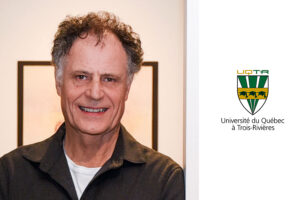
Philippe Boissonnet
A native of France, Philippe Boissonnet holds degrees from Paris I-Sorbonne (M.A., 1986) and UQÀM (PhD, 2013), and was Professor of Art at the Université du Québec à Trois-Rivières from 1993 to 2022, where he directed the Groupe URAV (Groupe universitaire de recherche en arts visuels). In 1983, he was awarded the Elizabeth Greenshields Foundation Prize (Montreal), followed by the Shearwater Foundation for the Holographic Arts (USA) in 1998 and the Hologram Foundation (Paris) in 2018. His artistic work spans several expressive forms and techniques: drawing, photography, copy art, holography, light art and interactive installation. His creations focus on an aesthetic of artistic cross-fertilization and the exploration of luminous transparency. His aim is to express the limits of our perception of the world, but above all the fragility of the world itself and the living beings it shelters. He has had solo exhibitions in Canada, Europe, the United States and Argentina, and has taken part in nearly 100 group shows (Canada, Europe, the United States, China, South and Central America, Japan, Australia and Egypt).
The holographic imagination, utopia of a future energy state?
More and more often, the aesthetics of holographic images can be found in scenic and visual artistic productions that use luminous and videographic 3D spatialization, even though they are not produced by a holographic process. After briefly defining the physical, perceptual and aesthetic nature of holographic images, I’ll present a few examples of pseudo-holographic practices that take holographic images as a model, to nourish a phantasmagorical utopia of spectral presence, doubling the real world and verging on teleportation. Suggesting our strong fascination with the total virtuality of bodies, these productions demonstrate the existence of a collective imagination that values a luminous informational energy capable of liberating us from the opacity of flesh, earthly gravity and physical distances. Pseudo-holographic works by artists such as David Spriggs, Slobodan Radosavljevic, the optical theater company 4DArt, the choreographic troupe Van Grimde Corps Secrets and Roseline de Thelin, as well as virtual stagings of Madonna, Michael Jackson and Maria Callas, are all part of the same imaginary. The holographic fictions found in films such as Star Wars and Avatar clearly demonstrate this utopia of a disembodied energetic state.