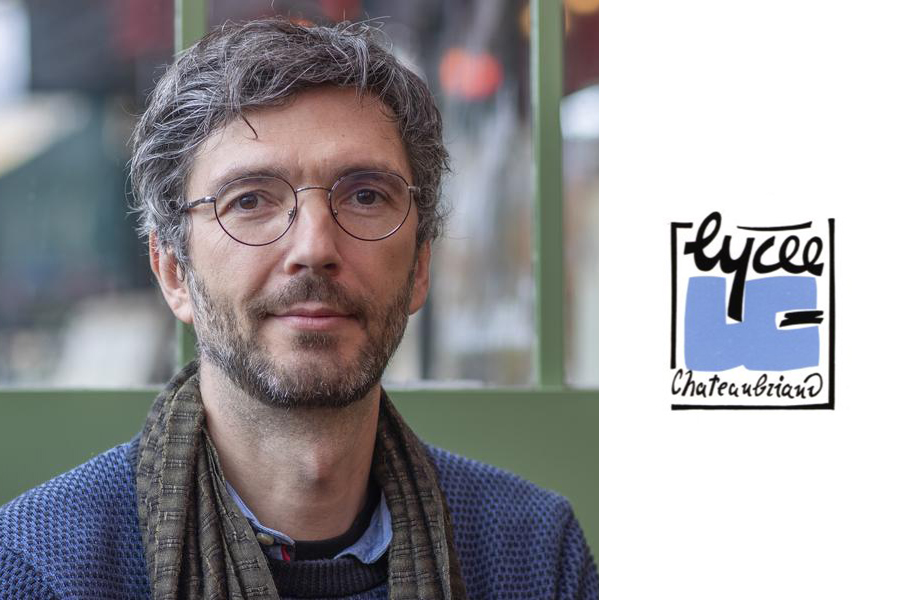
Maxime Abolgassemi
Biography
Maxime Abolgassemi teaches literature and general culture in preparatory classes at the Lycée Chateaubriand in Rennes. A proponent of pedagogical renewal, he has published a book promoting creative writing practices in the teaching of French. Drawing on his experience as a jury member for various competitive examinations and as a teacher, he has developed a practical method that takes into account the multiple issues raised by the “personality interview” tests used in entrance exams for the grandes écoles. He holds a doctorate in literature (Université Paris-Sorbonne) and an agrégation in modern literature, as well as a master’s degree in theoretical physics (Université Pierre-et-Marie-Curie). His work focuses on the Surrealists’ “objective chance”, the notion of counterfiction he introduced, and democratic transparency. In 2017, he published Nuit persane, a first novel that plunges the reader into Tehran in the final years before the Iranian Revolution.
Conference: Did Victor Hugo save time with big data?
The rise of algorithms capable of intelligently processing and interpreting megadata will save us an almost fabulous amount of time in virtually every field, from disease forecasting to fraud detection. This extraordinary innovation is part of the logic of a more general model, which has made these feats possible: the world of democratic transparency, which we don’t always clearly identify. Yet art and (especially) literature have played a major role in this advent. Big Data, and probably artificial intelligence to come, is based on three postulates: universalization, egalitarianism and value inversion. This last original characteristic has made its way through the history of art, via the Surrealist “lost object” and modern art, until it was finally developed digitally by our new computing infrastructures. And it’s Victor Hugo, in a key scene from Les Misérables, who provides us with a striking starting point.